
Section 01
Executive Summary
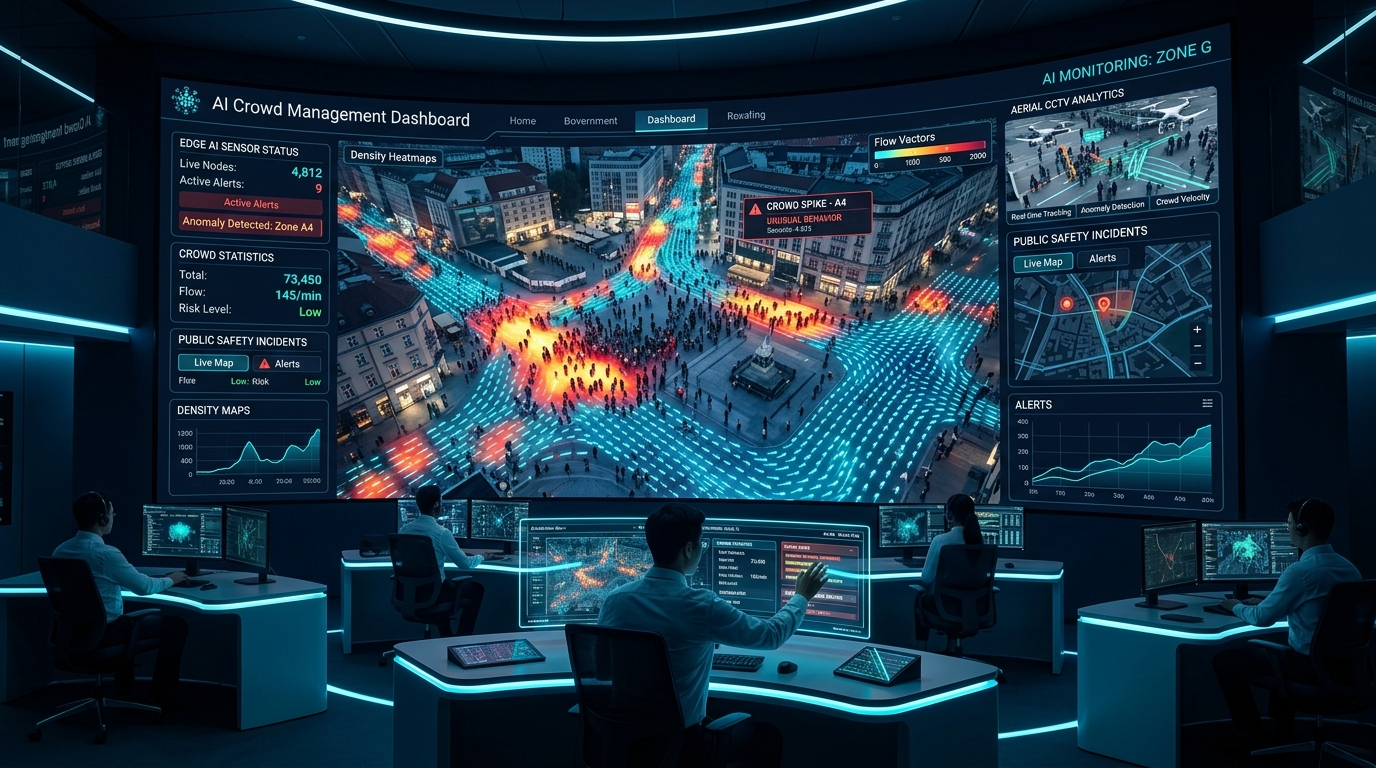
CROWDLENS is a real-time, privacy-first AI platform designed to predict and prevent crowd-related disasters by transforming passive CCTV networks into proactive public safety guardians.
Leveraging computer vision, edge AI and predictive analytics, the system detects early warning signs of dangerous crowd behavior and structural overloads before they escalate into tragedies. Build a production-ready prototype that ingests live or recorded video, analyzes crowd dynamics in real time, predicts safety threats with under 2-second latency, and maintains absolute privacy — no facial recognition, no individual tracking.
Core innovation: turn every camera into a predictive safety sensor — without ever identifying a single person.
Section 02
The Invisible Crisis in India's Crowds
India sees over 2,500 crowd-related incidents annually — 1,000+ deaths in five years, 10,000+ injuries, and ₹5,000+ crores in economic loss. Despite 30M+ CCTVs, 99% of monitoring is reactive: guards watch hundreds of screens, structural risks are never monitored live, and no Indian city uses AI for crowd safety at scale.
| Incident | Year | Location | Casualties | Root Cause | AI Prevention |
|---|---|---|---|---|---|
| Maha Kumbh Mela Stampede | 2019 | Prayagraj, UP | 40+ dead | Crowd surge at bridge bottleneck | Density + Flow Analysis |
| Elphinstone Road Stampede | 2022 | Mumbai, MH | 22 dead | Post-event rush, poor barricading | Reverse Flow Detection |
| Rajasthan Temple Tragedy | 2023 | Rajsamand, RJ | 35+ dead | Narrow exit, unmanaged queue | Bottleneck Flow Rate |
| Morbi Bridge Collapse | 2022 | Morbi, GJ | 135+ dead | Structural overload | Mass Load Estimate |
| Chennai Stadium Crush | 2021 | Chennai, TN | 12 dead | Sudden surge after match | Stampede Risk Index |
Current systems answer “What just happened?”. CROWDLENS must answer “What is about to happen — and where?”
Section 03
Problem Drivers
Urbanization & Mass Events
600M+ urban population by 2030; religious gatherings draw 50M+ pilgrims annually; transport hubs handle millions daily with zero crowd intelligence.
Aging Infrastructure
70% of bridges are 50+ years old; venues designed for 1980s crowd sizes; no real-time structural load monitoring.
Surveillance Without Intelligence
Passive forensic-only cameras; 20-minute attention span means ~40% of critical events are missed.
Economic & Legal Pressure
Organizers cut crowd-management costs; insurance spikes after incidents; no proactive mitigation tooling exists.
Global Lessons Ignored
Seoul 2022 (158 dead) triggered nationwide AI monitoring; UK stadiums cut incidents 60%; Singapore predicts surges at 92% accuracy.
The Opportunity
India does not need to reinvent the wheel — it needs to deploy it at scale before the next tragedy.
Section 04
Objectives & Success Metrics
Primary objective: a prototype that ingests feeds, analyzes crowd dynamics with CV and predictive models, predicts surges and structural overloads before they occur, and pushes actionable location-specific alerts in under 2 seconds.
| Success Metric | Target | Why It Matters |
|---|---|---|
| Stampede Prediction Precision | ≥ 80% | Fewer false alarms = trust from security teams |
| Alert Latency | < 2 seconds | Faster than human reaction time |
| Privacy Compliance | 100% | No facial recognition, no individual tracking |
| Structural Load Accuracy | ±15% of ground truth | Prevents bridge/staircase collapses |
| Crowd Density mAP | ≥ 0.78 | Accurate counting in dense scenes |
| Stretch Goal | Description |
|---|---|
| Multi-Camera Fusion | Correlate angles for 3D crowd modeling |
| Edge Deployment | Raspberry Pi + Coral TPU, offline capable |
| Mobile Responder App | GPS-tagged alerts to security phones |
| Historical Replay | Scrubbable post-incident timelines |
| Audio Fusion | Microphone-based aggression detection |
| Real-Life Demo | Actual crowd footage with measurable accuracy (100 bonus marks) |
Section 05
Crowd Taxonomy & Event Context
| Event Type | Visual Signatures | Risk Profile |
|---|---|---|
| Temple Festival | Traditional attire, diyas, narrow corridors | High stampede risk in bottlenecks; rear crowds unaware of front compression |
| Sports Stadium | Uniform colors, seated sections, wave patterns | Crush risk at exits; post-match surge compression |
| Concert / EDM | Stage-facing, raised hands, phone lights | Trampling; mosh pit density spikes; heat exhaustion clusters |
| Protest / Rally | Flags, banners, police lines, chanting | Rapid escalation to volatile; kettling; dispersal patterns |
| Procession | Linear movement, slow pace, intermittent stops | Compression at halts; stop-wave propagation |
| Public Gathering | Mixed orientation, static clusters | General density management; vulnerable demographics |
| Dynamics State | Definition | Visual Biomarkers |
|---|---|---|
| Passive | Static/slow-moving; low energy | Standing still, seated, minimal arm movement |
| Active | Purposeful movement; normal energy | Walking, queueing, cheering, clapping |
| Aggressive | Hostile body language; confrontation | Chest-forward posture, pointing, pushing |
| Volatile | Unstable; rapid state-switch potential | Sudden direction changes, raised voices |
| Panic | Flight response; disordered evacuation | Running against flow, falling, dropped items |
| Dispersing | Controlled/uncontrolled exit | Radial outward flow, emptying central zones |
Section 06
Analytics Engine: Detection & Prediction
Demographic profiling is aggregate-only: age and group mix derived from silhouette gait and body proportions, reported as histograms per 5m × 5m grid cell. Never per-person records.
| # | Feature | Source | Physics Meaning |
|---|---|---|---|
| F1 | density_ppm2 | Detection grid | People/m² (>6 = danger) |
| F2 | velocity_mean | Optical flow | Average movement speed |
| F3 | velocity_variance | Optical flow | Speed inconsistency = turbulence |
| F4 | direction_entropy | Heading vectors | Low = laminar, high = chaotic |
| F5 | compressibility_index | Density gradient | Rate of density increase |
| F6 | pressure_proxy | Social force model | F = density × velocity² (crush risk) |
| F7 | bottleneck_flow_rate | Gate/exit ROI | People/minute through chokepoints |
| F8 | queue_disorder | Line detection | Deviation from straight queue |
| F9 | fallen_person_flag | Pose estimation | Horizontal body in crowd |
| F10 | arm_raised_ratio | Pose keypoints | Cheering vs. distress |
| F11 | jumping_frequency | Vertical motion FFT | Rhythmic vs. irregular |
| F12 | interpersonal_distance | Detection spacing | Collapsing distance = compression |
| F13 | reverse_flow_ratio | Direction analysis | % against dominant flow |
| F14 | edge_pressure | Barrier proximity | Stacking against fences/walls |
| F15 | age_vulnerability_index | Aggregate demographics | Children + elderly in dense zones |
| F16 | stop_wave_propagation | Temporal analysis | Front-stop signal traveling backward |
| F17 | audio_aggression_proxy | Spectral analysis | Low-frequency energy surge |
| F18 | structural_load_kN | Density × avg weight | Force on deck/stair tread |
| F19 | vibration_resonance | Video motion mag. | Oscillation under rhythmic crowd |
| F20 | time_to_critical | Predictive model | Minutes until stampede threshold |
Stampede Risk Index (SRI)
SRI = 0.30 × f(density_ppm2)
    + 0.20 × f(pressure_proxy)
    + 0.15 × f(velocity_variance)
    + 0.15 × f(compressibility_index)
    + 0.10 × f(reverse_flow_ratio)
    + 0.05 × f(fallen_person_flag)
    + 0.05 × f(age_vulnerability_index)
Prediction horizon: time-series forecast on the last 90 seconds of features. Output format: “Stampede risk critical in 4 minutes at Zone-B”.
| Structural Signal | Detection Method | Threshold |
|---|---|---|
| Mass Load Estimate | Headcount × 70kg avg | vs. rated capacity (e.g. 5kN/m²) |
| Dynamic Load Factor | Rhythmic jumping/marching frequency | Resonance if crowd freq ≈ natural freq |
| Visual Deformation | Motion magnification of handrail/deck | > 2mm displacement |
| Flow-Induced Vibration | Camera shake frequency analysis | Anomalous oscillation patterns |
IF mass_load > 0.80 × rated_capacity AND dynamic_factor > 1.5:
    TRIGGER "Structural Overload Warning"

IF visual_deformation > 2mm OR resonance_detected:
    TRIGGER "Immediate Evacuation of Structure"
Section 07
Technical Requirements
| CV Component | Recommended Models / Methods |
|---|---|
| People Detection | YOLOv8 / RT-DETR / YOLO-NAS |
| Multi-Object Tracking | ByteTrack / OC-SORT (ephemeral IDs) |
| Pose Estimation | MoveNet / YOLOv8-pose |
| Optical Flow | Farneback / RAFT |
| Motion Magnification | Eulerian video magnification |
| Backend Component | Technology | Purpose |
|---|---|---|
| Stream Processing | Kafka / Redis Streams | Multi-camera feed ingestion |
| Time-Series DB | InfluxDB / TimescaleDB | Per-second feature storage |
| Prediction API | FastAPI | SRI & structural alerts (<500ms) |
| Geospatial Grid | PostGIS / custom grid engine | Pixel-to-real-world mapping |
| Alert Bus | WebSocket / SSE | Push alerts to dashboards & mobile |
Dashboard must-haves
- — Multi-camera mosaic with color-coded zone overlays
- — Toggleable heatmaps: density, turbulence, stampede risk
- — Auto-classified event archetype badge with confidence
- — Dynamic crowd state panel (Passive → Panic)
- — Predictive SRI timeline with forecast line
- — Structural load gauge with resonance indicator
- — Auto-generated incident log
Privacy & ethics architecture
- — No facial recognition — gait/silhouette only
- — Ephemeral IDs, no persistence beyond frame sequence
- — Aggregate histograms per zone, no individual records
- — Audit trail of every alert with feature snapshot
- — Consent zones with visible anonymous-AI signage
Section 08
Evaluation & Scoring — 200 Marks
| # | Metric | Target | Marks |
|---|---|---|---|
| M1 | Crowd Detection mAP | ≥ 0.78 | 15 |
| M2 | Event Type Classification Accuracy | ≥ 0.85 | 10 |
| M3 | Dynamics State F1 (6-class) | ≥ 0.75 | 15 |
| M4 | Stampede Prediction Precision | ≥ 0.80 | 20 |
| M5 | Fallen Person Detection Recall | ≥ 0.90 | 10 |
| M6 | Structural Load Correlation | ±15% ground truth | 10 |
| M7 | Alert Latency | < 2 sec | 10 |
| M8 | Presentation & Ethics | — | 10 |
| Bonus Category | Criteria | Max Marks |
|---|---|---|
| Innovation | Novel algorithms, unique features, creative problem-solving | 40 |
| New Features | Audio fusion, mobile app, edge deployment | 30 |
| Real-Life Demo | Actual crowd footage with measurable accuracy | 30 |
Penalty — 48–72 hrs late: −10 marks · 72–96 hrs late: −20 marks
Section 09
Deliverables
| ID | Item | Details |
|---|---|---|
| D1 | CV/ML Pipeline (/ml) | Detection, tracking, optical flow, pose estimation, SRI model, structural analysis. |
| D2 | Backend & Streaming (/backend) | Ingestion API, time-series DB, WebSocket alert bus, <500ms prediction endpoints. |
| D3 | Dashboard (/dashboard) | Multi-camera view, heatmaps, predictive timeline, structural gauges. |
| D4 | Dataset (/data) | 10+ annotated clips (UCF Crowd, WWW Crowd, FDST or synthetic). |
| D5 | Model Card | Per-event performance, confusion matrices, failure modes. |
| D6 | Demo Video (2 min) | Upload clip → classify → heatmap → SRI climbs → alert → structural gauge. |
| D7 | Slide Deck (10 slides) | 8-min presentation + 4-min Q&A. |
| D8 | Innovation Documentation | New features, algorithms, real-life testing evidence. |
Section 10
48-Hour Sprint Timeline
| Hours | Phase | Tasks | Milestone |
|---|---|---|---|
| 0–2 | Setup & First Light | Repo init, CV pipeline scaffold, test video curation | First frame processed with detection boxes |
| 2–8 | Core Detection Stack | Detection + tracking on dense scenes, optical flow, density grid | Density heatmap rendering live |
| 8–18 | Intelligence Layer | Event classifier, dynamics states, SRI scoring, fallen-person detection | Alert triggers on test video |
| 18–24 | Dashboard Integration | Dashboard live, WebSocket alerts, multi-camera mosaic | Real-time overlay on dashboard |
| 24–36 | Structural & Advanced | Load module, motion magnification, time-series forecasting | Structural gauge functional |
| 36–44 | Polish & Privacy Audit | Privacy audit, latency optimization, edge-case testing | Ethics architecture verified |
| 44–48 | Final Assembly | Demo video, deck, README, real-life demo testing | Repo locked & submitted |
Pro tip for 2-member teams — Member 1: CV pipeline + backend (hours 0–24). Member 2: dashboard + integration (hours 12–48). Overlap 12–24 on API contracts and data flow.
Section 11
Judging Criteria
| Criteria | Weight | What Wins |
|---|---|---|
| Safety Prediction | 25% | High stampede precision, plausible structural load, low false alarms, countdown-to-critical |
| Privacy-by-Design | 20% | Aggregate-only analytics, zero facial recognition, ephemeral IDs, transparent signage |
| Crowd Science Depth | 20% | Social force modeling, pressure physics, turbulence metrics, age-vulnerability weighting |
| System Integration | 15% | Video → detection → scoring → alert → dashboard, <2s latency, multi-camera |
| Presentation | 10% | Public safety narrative, deployment path, confident Q&A |
| Technical Robustness | 10% | Clean code, optimized models, scalable architecture |
Section 12
Constraints & Disclaimers
- Decision support only. Trained personnel must validate all alerts. CrowdLens augments human judgment; it does not replace it.
- Privacy is non-negotiable. If the database is breached, no individual may be identified or profiled. Aggregate histograms only.
- Synthetic data limitations. Models trained on synthetic scenes may not generalize to real festival densities, lighting or cultural clothing. Field validation is required.
- Bias awareness. Gait-based age estimation and clothing-based classification carry demographic bias risk. Document accuracy variance across attire and body types in your model card.
- Liability. CrowdLens provides probabilistic risk assessment only. Event organizers remain responsible for physical safety measures, capacity enforcement and emergency protocols.